“Fue” or “era”? The great Spanish dilemma
There is something I see constantly in my Spanish classes: students with a very good level who still hesitate between “fue” and “era”.
And I’m not talking about beginners. I’m talking about people who already speak Spanish quite fluently, who understand series, podcasts, and real conversations… but then they get to this sentence and suddenly stop to think:
“La fiesta fue muy divertida”
“La fiesta era muy divertida”
If this also happens to you, I have good news:
you are not the only one.
And that is exactly why I wanted to write this article.
The problem is not the rules
Many students think they need to memorize more grammar.
But normally, that is not where the problem is.
The key is something much simpler:
the way we see the action.
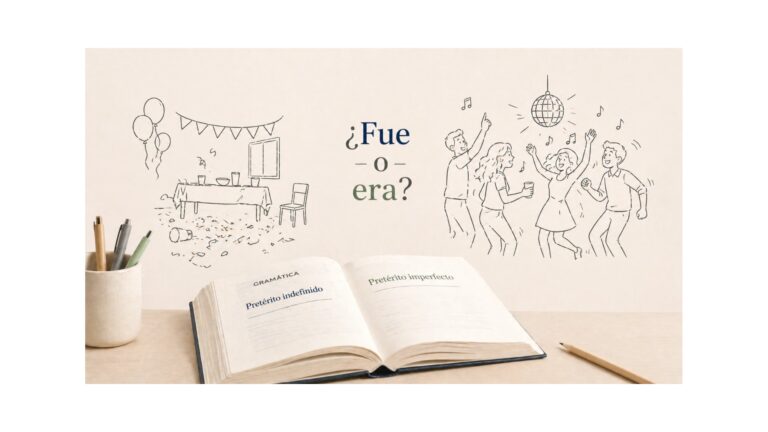
The pretérito indefinido: looking at the action from the outside
When we use the indefinido (“fui”, “llegué”, “trabajé”…), we see the action as something complete and finished.
Like a movie that has already ended.
Examples:
- “Ayer trabajé todo el día”.
- “Llegué a casa y me senté en el sofá”.
- “La fiesta fue increíble”.
Here, we see the action from the outside.
It started and ended.
The pretérito imperfecto: being inside the scene
With the imperfecto (“era”, “vivía”, “cantaba”…), we do something different:
we describe a situation while it was happening.
We are not talking about the end.
We are simply inside the scene.
Examples:
- “Cantaba una canción cuando llegó mi hermano”.
- “En 2014 estudiaba en la universidad”.
- “La casa era muy moderna”.
Here, it does not matter when the action started or ended.
We only see the situation “in progress”.
So… “fue” or “era”?
Let’s go back to the big question:
“La fiesta fue increíble”
“La fiesta era increíble”
Both sentences can be correct.
The difference is the perspective.
- “La fiesta fue increíble” → you are talking about the whole experience, already finished.
“La fiesta fue increíble. Lo pasamos genial”.
- “La fiesta era increíble” → you are inside the party, describing what you were experiencing at that moment.
“La fiesta era increíble: la música, la comida, la gente…”
The most important idea is this:
- With “fue” → you see the party from the outside.
- With “era” → you are still inside the scene.
And here comes the interesting part…
Many students understand this perfectly in theory.
But later, while speaking, they say:
“Era muy divertido” when they actually want to say “fue muy divertido”.
And do you know what?
That is normal.
Because this is not only grammar.
It is a different way of thinking about the action.
The most important thing: patience
This contrast takes time.
You do not learn it in one afternoon.
Not even after doing a few exercises.
In fact, it is one of the most difficult topics even for advanced students.
But little by little, everything starts to make sense.
And when it finally clicks…
your Spanish changes a lot.
To finish
If you have ever hesitated between:
- “fue” and “era”,
- “viví” and “vivía”,
- “estuve” and “estaba”…
welcome to the club.
And if you want to work on these kinds of things with clear examples and explanations,
you already know where to find me 🙂